November 24, 2012

Rocks and Molotov Cocktails Mark a New Intifada in Judea and Samaria

Arab students from the Birzeit University cover their faces during clashes with Israeli soldiers at the Atara checkpoint close to their university as they protest against Israel's military action on the Gaza Strip. November 19, 2012.
Photo Credit: Issam Rimawi/FLASH90
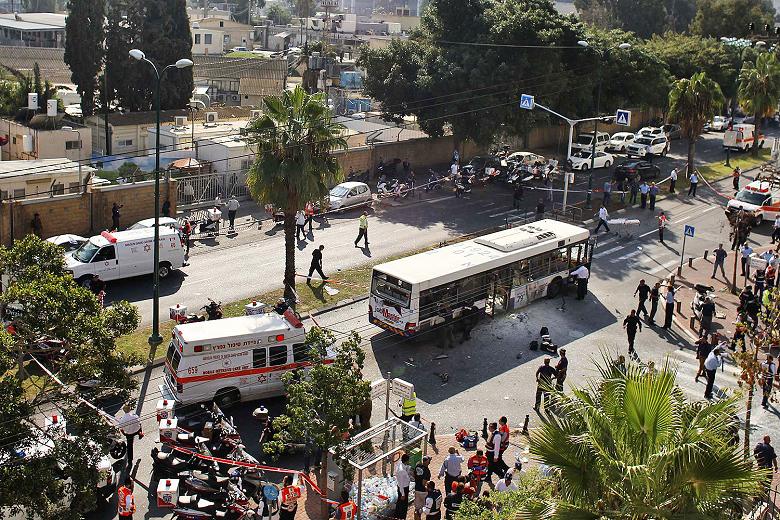
The fire from Gaza has been spreading to Judea and Samaria in recent days, with a steady increase in the number of attacks and violent riots against Jewish civilians and against the security forces. Around 10 PM Monday, Arabs threw several Molotov cocktails at an Egged bus near the community of Adam. Arabs also burned two tires on the road, the Jewish Voice reported.

Earlier, around 6 PM, Arabs threw three Molotov cocktails at the car of a resident of Ma'aleh Levonah, near the village of Sinjil. One Molotov cocktail entered the car and ignited a fire. The driver and a passenger escaped the burning car which rolled down into a canyon and burned to the ground.

Read More:

http://www.jewishpress.com/news/breaking-news/rocks-and-molotov-cocktails-mark-a-new-intifada-in-judea-and-samaria/2012/11/20/?print

Middle East Crises of 2013 Already in Dress Rehearsal

F120704IR01
Photo Credit: Issam Rimawi/Flash90
Originally published at Rubin Reports.

If 2011 was the year of the Arab Spring, 2013 looks to be the year of the Arab Fall. The hopes of quick, easy democracy have already been eclipsed by the rise of radical Islamist groups, which are no less extreme for coming to power through elections. And so the coming months are likely to see more disillusion, violence, and the entrenchment of Islamist regimes.

Let’s start with the Gaza Strip. Hamas is determined to fight Israel in the belief that it can win total victory. Its five years in power have had no moderating effect and it doesn't care how much of Gaza is destroyed, how much the people there suffer, or how many are killed. It puts a priority on jihad and hopes that international pressure will always stop Israel from continuing its retaliation too long, much less overthrowing the regime there.

Hamas may be moved by fearing that the regime might fall, the people might turn actively against it (but with Fatah not trying to overthrow Hamas a real internal threat is unlikely). But the key factor is how much help Hamas can expect from Egypt. Right now and in the current war, Egypt is still cautious. The regime hasn't really entrenched itself in power, begun Islamizing the country, and consolidated control over the army. But in the coming months, as the regime needs to distract its peoples attention from failures and mobilize support the next war with Hamas might involve some higher level of Egyptian involvement. And that would really be a conflict to shake the Middle East.
Read More:

http://www.jewishpress.com/indepth/analysis/rubin-reports/middle-east-crises-of-2013-already-in-dress-rehearsal/2012/11/21/0/?print


Admitting the Mistake of the Disengagement

"Why?"
"Why?"
Photo Credit: Flash90
On Sunday, Wall Street Journal editor and columnist Bret Stephens did what too many need to do: own up to the mistake of supporting the Disengagement Plan.

At the time, Stephens was editor-in-chief of the Jerusalem Post.

In his WSJ column Stephens wrote that on each of the points he argued regarding the Disengagement plan he turned out to be wrong. He writes:
My error was to confuse a good argument with good policy; to suppose that mere self-justification is a form of strategic prudence. It isn't. Israel is obviously within its rights to defend itself now against a swarm of rockets and mortars from Gaza. But if it had maintained a military presence in the Strip, it would not now be living under this massive barrage.

Or, to put it another way: The diplomatic and public-relations benefit Israel derives from being able to defend itself from across a "border" and without having to get into an argument about settlements isn't worth the price Israelis have had to pay in lives and terror.

...

Put simply, Israel's withdrawal from Gaza yielded less security, greater diplomatic isolation, and a Palestinian regime even more radical and emboldened than it had been before. As strategic failures go, it was nearly perfect.

One of the most inspiring possessions I own sits in my office at shul (synagogue). I received it in 2006 when I went with a group of my shul members to Israel to volunteer in the North in the wake of the second Lebanon war. On that mission, we toured Sderot and saw firsthand the damage and destruction left by kassam rockets and the metal pellets that were packed therein. Eli Moyal, then mayor of Sderot, described to us what it means to have 15 seconds to find cover when a warning siren is sounded. We asked him how the people of his city, and the South in Israel in general, have persevered. For years, the parents of Sderot have sent their children to school not knowing if their sons and daughters will come home. Every time they leave their houses, residents of Sderot must be cognizant of the closest bomb shelter in case a siren goes off. We asked Moyal, How have they found the strength and capacity to endure such a lifestyle?

I am humbly aware that I have no answers to the questions that we are all asking at this troubled time. Why are we being confronted with these tragic challenges? What does G-d want from us? What message is He sending? Are we being punished? If so, why? Is Moshiach, the Messiah, coming?
Photo Credit: The Times
I begin by stating that no one has answers to these questions. Yes, I know that many, greater than I, have been publicly proclaiming answers to these questions. They claim, I suppose, to have access to some Higher Source. I have no such access and doubt that anyone alive today possesses such knowledge. The powers of prophecy were taken away from us long ago.

Read More:

http://www.ou.org/life/israel/reflections-on-new-reality-tzvi-hersh-weinreb/#.ULGhQmeulI5

You Need to Fight Israel’s Second War

One of the most inspiring possessions I own sits in my office at shul (synagogue).
I received it in 2006 when I went with a group of my shul members to Israel to volunteer in the North in the wake of the second Lebanon war.  On that mission, we toured Sderot and saw firsthand the damage and destruction left by kassam rockets and the metal pellets that were packed therein.  Eli Moyal, then mayor of Sderot, described to us what it means to have 15 seconds to find cover when a warning siren is sounded.
We asked him how the people of his city, and the South in Israel in general, have persevered. For years, the parents of Sderot have sent their children to school not knowing if their sons and daughters will come home.  Every time they leave their houses, residents of Sderot must be cognizant of the closest bomb shelter in case a siren goes off.  We asked Moyal, How have they found the strength and capacity to endure such a lifestyle?

Read More:

http://www.ou.org/life/israel/you-need-to-fight-israels-second-war-efrem-goldberg/#.ULGg_meulI5

"The True Response: Returning to Gush Katif"

At the end of a tour in the south, the leaders of Women in Green state that the only response that will bring quiet to the south is not to rely solely on a military operation, but to take civilian possession of the Gaza Strip, that is, to return to Gush Katif

Women in Green leaders Yehudit Katsover and Nadia Matar conducted yesterday, Monday November 19th, a tour in the south in which they met the inhabitants of Otef Gaza (the area around the Gaza Strip), along with IDF soldiers in readiness for possible entry to the Gaza Strip.
Katsover and Matar distributed treats to the soldiers - drinks and cookies - and spoke with many of them. They say that these conversations were filled with a spirit of willingness to sacrifice, out of an understanding of the value of the operation. This said and done, they add that as long as civilian possession of the Gaza Strip is not restored, that is, the reestablishment of the Gush Katif communities, there will be no end to the rocket fire from the Strip and the strengthening of Hamas there.
Read More:

http://womeningreen.org/returntogushkatif.php

What You Are Not Hearing

Even though you are probably reading every article, blog, website and news release about the "campaign" in Gaza, I want to share something with you that you will not read anywhere else.

It is a story about a dear friend of mine named Yitzchak Neuman. Yitzchak made aliyah from Queens (New York) in 1989 and began his life in Israel studying full time in a Yeshiva. After a few years, his father passed away (back in NY) and during the shiva, his mother asked that he begin his college education right away. Yitzchak was an only child and decided to do what his mother requested. Immediately after the shiva, he came back to Israel and enrolled in Bar Ilan University. In order to continue his Talmudic studies he participated in the Bar Ilan "Bet Midrash" program which combines university study with an intense Judaic program. Things were going well. He was at the top of his class in his Biology major and also the top of the class in the Tamud program.

The year was now 1995 and he was in his final year of Bar Ilan University. At the same time, Yitzchak – like tens of thousands of others - was also very active protesting against the Oslo Accords which were signed in 1993 and which were responsible for shedding a tremendous amount of Jewish blood. Whenever his schedule allowed, he would attend rallies and demonstrations against the horrific "peace process" which had been signed by Rabin and Peres. When Rabin was murdered in November 1995, Yitzchak Neuman sent out an email which said, "Ding dong the witch is dead, the wicked witch is dead." Officials at Bar Ilan – already embarrassed by the fact that Rabin's alleged assassin attended Bar Ilan – were furious over this 11 word email and immediately expelled Yitzchak Neuman from the university.


Read More:

http://www.mflikud.com/eng_contents/articles/73/SackettWhat%20youarenothearing.html

November 19, 2012

Dangers of a Palestinian state

Two Frogs lived together in a marsh. But one hot summer the marsh dried up, and they left it to look for another place to live in, for frogs like damp places if they can get them. By and by they came to a deep well, and one of them looked down into it, and said to the other, "This looks a nice cool place: let us jump in and settle here." But the other, who had a wiser head on his shoulders, replied, "Not so fast, my friend: supposing this well dried up like the marsh, how should we get out again?" (From Aesop's fables, 6th century BC).

Read More:

 http://www.ynetnews.com/articles/0,7340,L-4304544,00.html

Lessons for the World from a New Gaza War


F121115YS32
Originally published at Rubin Reports.

Update: A few sirens went off in Tel Aviv around 6:30 PM, November 15—not the whole system or the one outside my window but those a few blocks away—and didn’t stay on very long. Then there were two loud but short booms, the sound of anti-rocket missiles being fired. Rumors followed. This being the age of social media people insisted that something must have happened because somebody in California said so. Some people said with certainty that a rocket hit in this or that place, one claimed he saw the smoke from a building that had been struck. In the end, it was announced that a rocket from the Gaza Strip had been shot down far to the south. The atmosphere was reminiscent of 1991 when three dozen Iraqi rockets did hit Israel, one of them a few blocks from my home, and anti-missile batteries could be heard nightly firing at incoming missiles from Iraq.

Of course, there’s nothing funny about a war. Less than an hour’s drive to the south people are under fire. There are casualties on both sides, including civilians. This is a serious matter, made no less so by its relative familiarity. Yet there is a difference between the horrors of war and imagining away a conflict, an inescapable situation, because one wants to do so. Only by confronting the reality can there be the best possible response to a crisis. Wishful thinking or ignoring real conflicts makes things worse.

The new war between Hamas and Israel has a lot of important lessons for international diplomacy and U.S. policy today. It once again shows that a country, especially one faced by a hostile adversary who cannot be turned away by words or compromises, has limited choices. And in that case a government must do what it must do.

A key to the problem of Western comprehension of international realities is admirably summarized by a New York Times editorial on the subject:

“No country should have to endure the rocket attacks that Israel has endured from militants in Gaza, most recently over the past four days. The question is how to stop them permanently.”
Read More:

http://www.jewishpress.com/indepth/analysis/rubin-reports/lessons-for-the-world-from-a-new-gaza-war/2012/11/15/0/?print 

State Dept. Cites 12,000 Rockets in 12 Years as Justification for Israel’s Choice of Self Defense

Egyptian Prime Minister Hisham Kandil was paying a visit to Gaza, but it is doubtful that Egypt will be able to influence events.
The fallout of the Arab Spring continues, and the winter dance performances are complex indeed.

Newly installed Egyptian President Mohammed Morsi is firmly in the Muslim Brotherhood camp, but as the ruling leader of a vast country with gaping economic, political and religious divides, he may not be able to take the kind of expected hardline against Israel that might be expected.

Today, November 16, President Morsi sent his Prime Minister, Hesham Kandil, on a "humanitarian mission" to Gaza.  Kandil was traveling with a small delegation, but given the wracking poverty of so many in Egypt, it may be hard to justify a big showing of charity to outsiders.  In addition, Hamas is the sworn enemy of the Egyptian old guard military and security forces, and Morsi needs to keep the displeasure of those groups in check.  Complicating matters still further, is what is on the current dance card of U.S. President Barack Obama.  While many either congratulate or blame U.S. President Obama for ushering out former Egyptian President Hosnai Mubarek, and thereby helping to usher in Morsi, at the moment the Obama administration is firmly playing the role of Israel supporter, committed to Israel's right to self-defense and unequivocally casting Hamas as the party in the wrong in this November 2012 Gaza-Israel War.
Read More:

http://www.jewishpress.com/news/breaking-news/state-dept-cites-12000-rockets-in-12-years-as-justification-for-israels-choice-of-self-defense/2012/11/16/0/?print